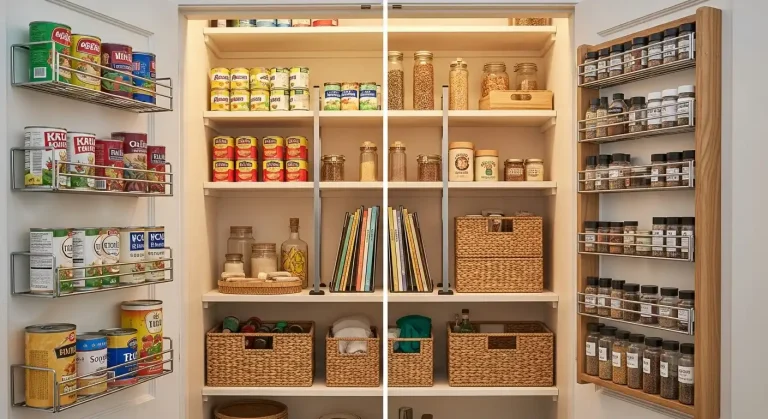
16 RV Pantry Cabinet Organization Ideas for Narrow Spaces

If you’ve ever opened your RV pantry after a long drive to find crackers on the floor and a jar of peanut butter rolled into the corner, you already know that home pantry advice doesn’t fully apply here.
RV pantry organization has to solve two problems at once. It needs to keep things visible and easy to grab in a tight footprint, and it needs to keep them exactly where you put them once the tires start moving.
That second part is what most pantry boards leave out. A pretty shelf means nothing if it dumps its contents at the first pothole.
So this roundup leans hard into the details that hold up on gravel roads and highway merges, retention bars, bungee cords, and deadbolt-grade latches, alongside the visual tricks that make a narrow cabinet easier to use every day: clear bins, matching labels, sliding baskets, and grip mats that let fresh fruit sit loose without a container.
Whether you’re working with a single narrow cabinet or a full walk-in pantry closet, there’s an idea below sized to fit. Save the ones that match your rig, and build your own system one shelf at a time.
1. Clear Pull-Out Bins Turn One Deep Cabinet Into Two Organized Zones
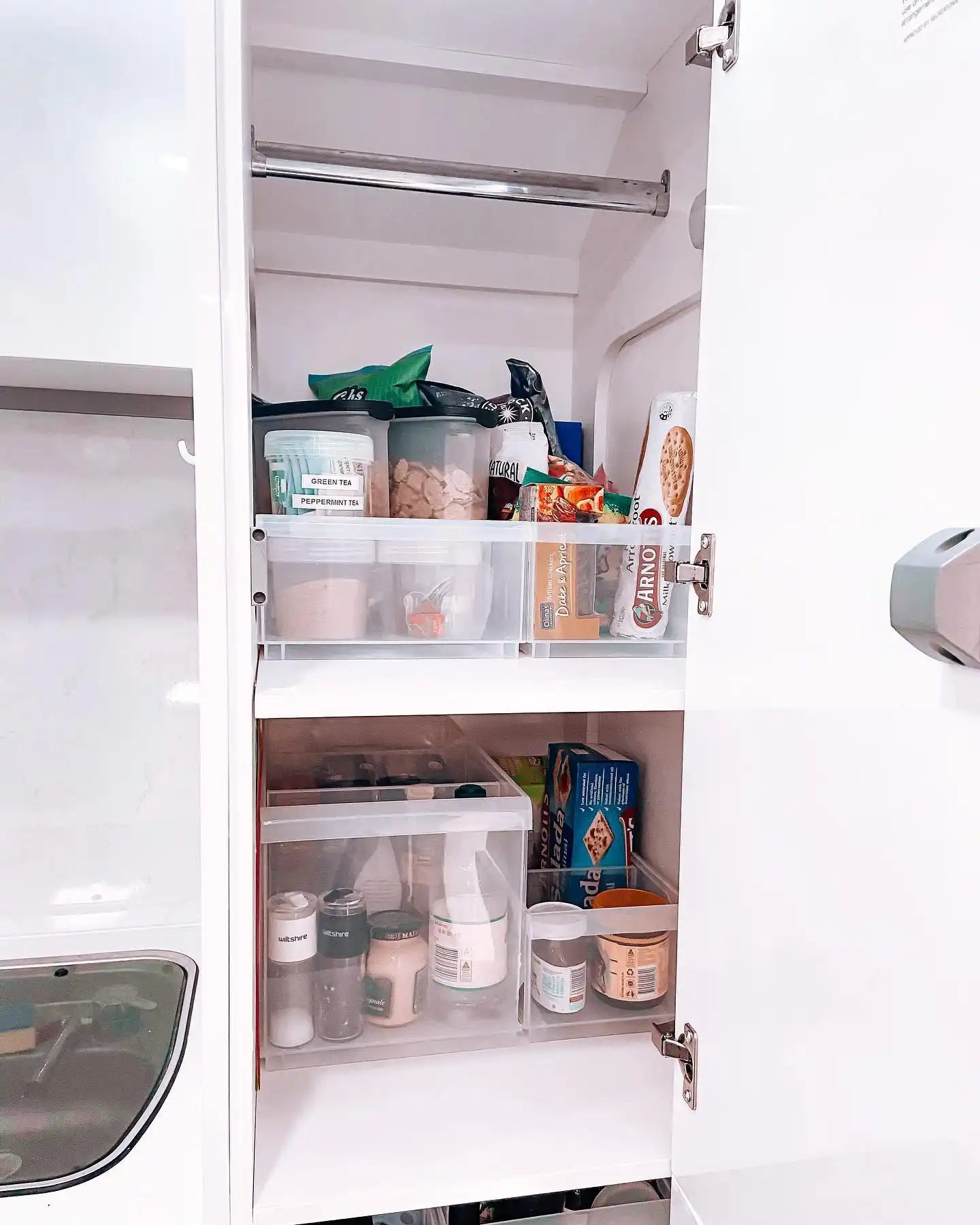
Narrow RV pantry cabinets are usually one tall, awkward space that swallows everything into a jumble.
This cabinet solves that by splitting each shelf into clear plastic bins, so instead of one deep zone you get several shallow ones you can actually see into and pull straight out.
A few things worth copying here:
- Loose tea bags and snack bags go into labeled clear tubs instead of floating around loose
- Jars and bottles stand upright in a low-sided caddy so nothing tips when the rig is moving
- Boxed crackers and crispbread are filed in vertically, spine up, like books, instead of stacked flat where they get crushed
- The top rod above the shelf is left open for hanging bags or foil rolls, so no vertical inch goes to waste
The setup only works because every bin is clear. In a narrow cabinet you are not opening lids to check contents, you are scanning at a glance.
Loose tea bags and snack pouches get their own tub so nothing rolls to the back and gets lost.
Jars and bottles stand in a shallow bin that keeps them upright even when the road gets bumpy.
Boxes stand spine up instead of stacked flat, so nothing at the bottom gets crushed.
2. Matching Labeled Containers Make a Tall Narrow Pantry Read Like One System
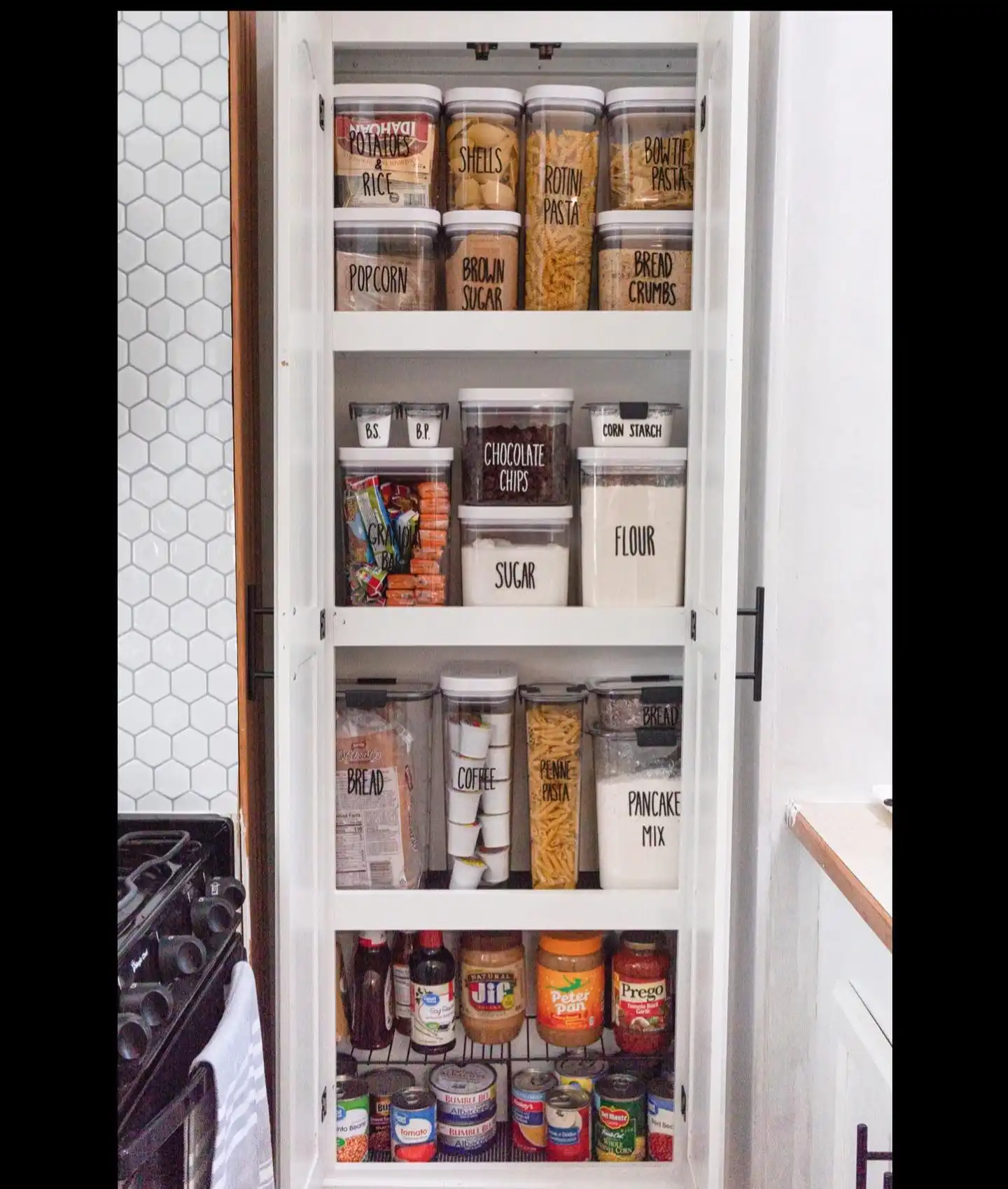
Four shelves stacked floor to ceiling, and not one of them looks like a different pantry. That is the trick here.
Every container is the same brand, same shape family, same handwritten label style, so pasta, flour, coffee pods, and pancake mix all belong to one visual language instead of fighting each other for attention.
Narrow RV cabinets tend to disappear into shadow past the second shelf. Labeling every container by name, not by category, fixes that.
You are not guessing what is behind “baking supplies,” you are reading “FLOUR” straight off the lid.
A few details worth stealing:
- Squat, wide containers on upper shelves for pasta and dry goods
- Tall skinny ones lower down for bread, coffee pods, and long noodles
- A wire shelf insert on the bottom level to keep cans and jars from sliding during travel
Label by the item name, not the category. “Flour” is faster to spot than “baking” when the cabinet is three shelves deep and the light is dim.
3. Sliding Wire Baskets Pull the Back of a Deep Cabinet Into the Light
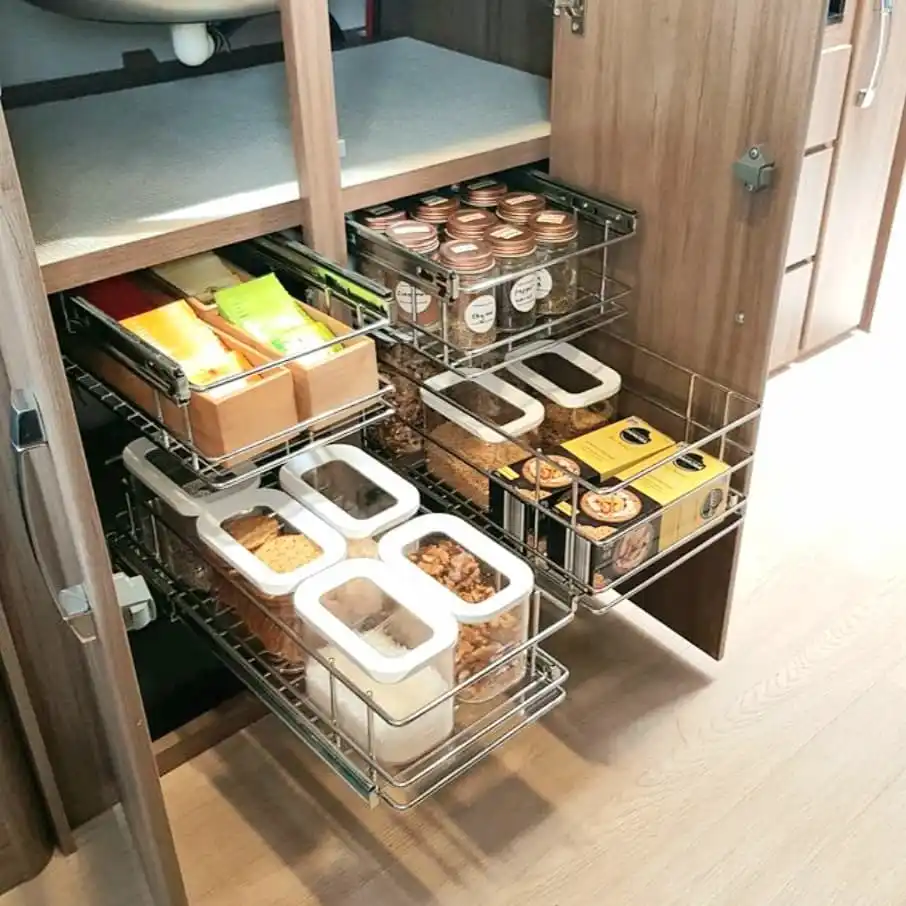
Under-counter cabinets in an RV are usually the ones nobody wants to dig through, since anything toward the back gets forgotten.
This setup swaps the fixed shelf for slide-out wire baskets, so instead of reaching into a dark corner, the whole basket rolls forward and everything sits at eye level.
What makes this one different from a stacked-shelf setup:
- Tea packets and snack bars stand upright in a small wooden divider box, filed like folders instead of loose in a pile
- Glass jars with copper lids ride in the top basket, labeled and grouped so spices or dry goods do not mix with snacks below
- Clear-lidded containers on the middle tier let you see cracker and cereal levels without opening anything
- The stagger between baskets, front one lower, back one higher, means nothing blocks your view when you pull the drawer
The trade-off is worth knowing before you copy this. Wire baskets need a cabinet with the depth and clearance to install slides, so it fits base cabinets better than shallow overhead ones.
| Fixed shelf | Sliding basket |
|---|---|
| Back items get lost in shadow. | Whole basket rolls out, back items reach you. |
| Cheaper, no installation. | Needs cabinet depth for slide rails. |
| Best for shallow overhead cabinets. | Best for deep base cabinets under counters. |
4. Ventilated Crate Baskets Keep Wooden Shelves From Turning Into a Can Jumble
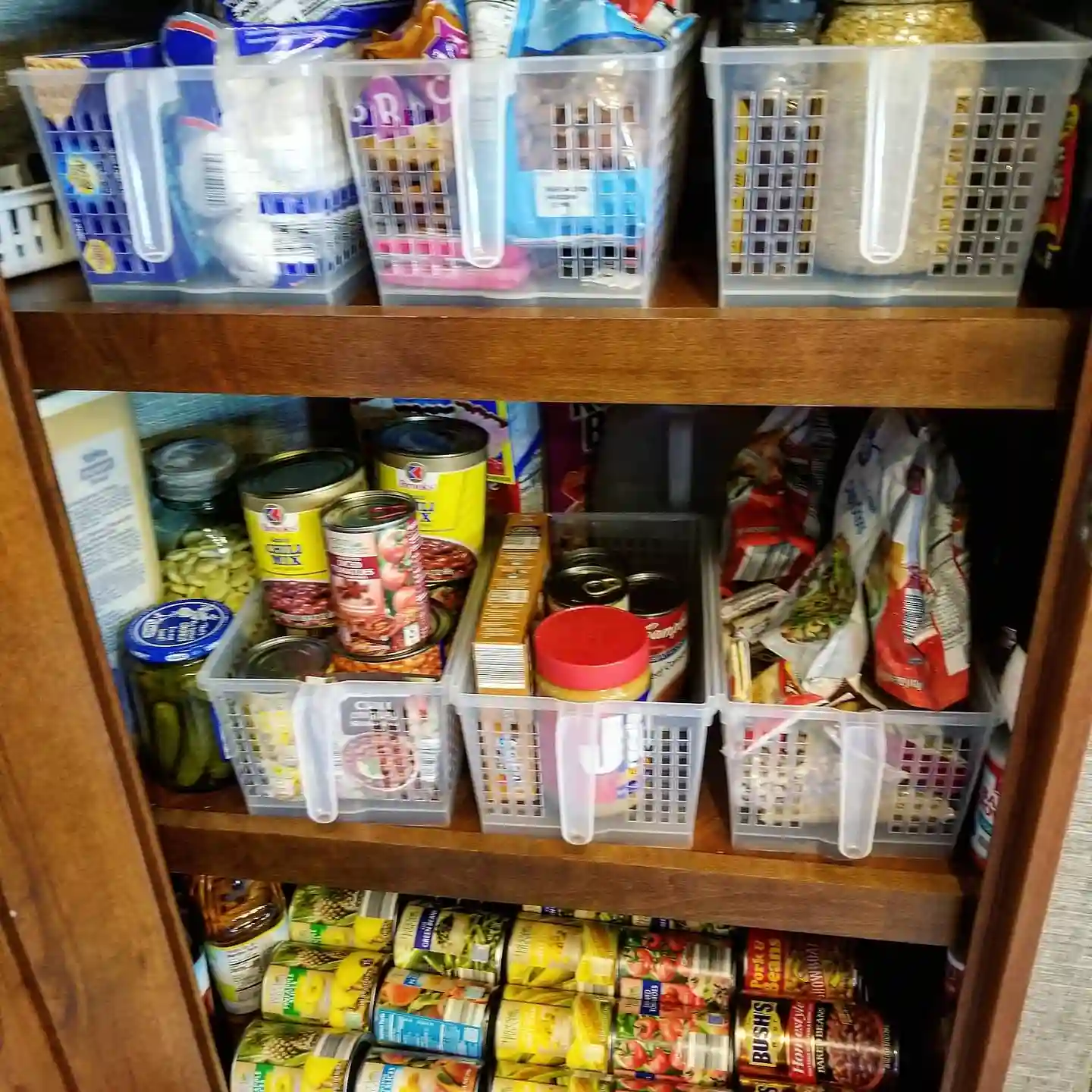
Wood-shelf pantries in older RVs and campers do not come with dividers, so cans, jars, and snack bags tend to slide into one long row the moment the rig hits a bump.
This shelf solves it with a row of ventilated plastic crates, each one a shallow, open-topped basket just big enough to corral a handful of items into their own lane.
The crates do double duty. Their slotted sides mean you can see what is inside without lifting anything, and the built-in handles let you slide a whole crate out to the counter instead of unloading cans one at a time.
Notice the shelf still keeps a mixed-use zone too, jars and loose bags on the left where a crate would not fit well, canned goods and snack bags corralled on the right. Not every inch needs a container, just the parts that would otherwise avalanche.
Group cans and jars into slotted crates so each cluster has its own lane.
Leave crate handles facing out so you can slide the whole thing to the counter.
Loose cans stacked straight on the wood shelf with no divider.
Packing crates edge to edge with no gap, since you lose the ability to pull just one out.
5. Stacked Cans and a Catch-All Bin Handle the Shapes a Shelf Can’t Line Up Neatly
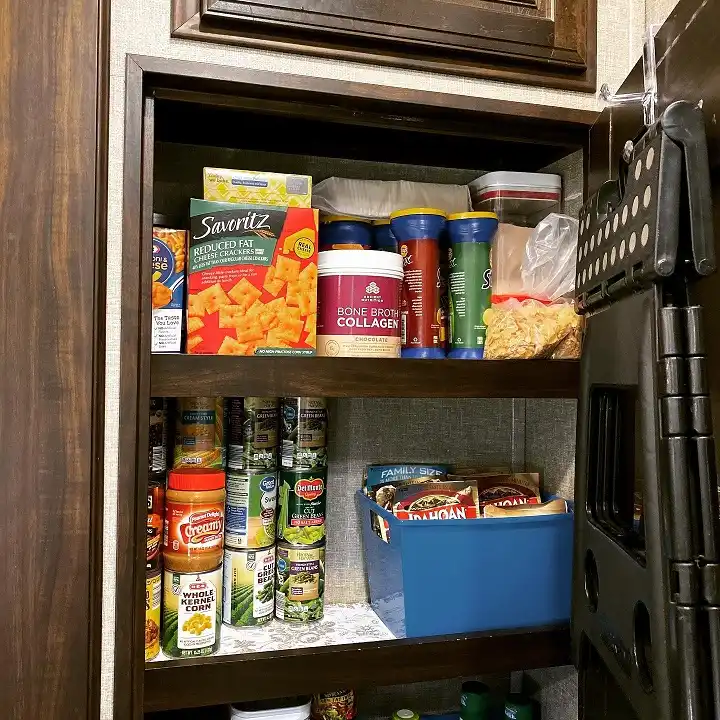
Six cans of beans and corn line up in two tidy towers here, and that stacking is doing more work than it looks like.
Canned goods are the one pantry item built to stack safely, so turning them into columns instead of a single row doubles what a shelf can hold in the same footprint.
The awkward stuff, family-size taco shell boxes and mixed packet meals, goes into one flexible bin instead of fighting for its own row, since odd shapes waste space when they’re forced into straight lines.
A non-slip liner runs under the canned goods, which matters more in an RV than a house kitchen.
Every stack here is one pothole away from toppling without it. And up on the cabinet door, a hanging wire rack claims space that would otherwise sit empty, holding lighter snack bags where floor-to-ceiling shelf space is not needed.
- Stack cans in matched pairs so each tower stays even and does not lean
- Use one non-fitted bin for oddly shaped boxes instead of forcing them into a row
- Line shelves with a grippy liner under anything stacked more than two high
- Mount a hanging rack on the door for lightweight bags that don’t need shelf depth
6. Decanted Oils in Matching Bottles Turn a Cluttered Shelf Into a Grab-and-Pour Station
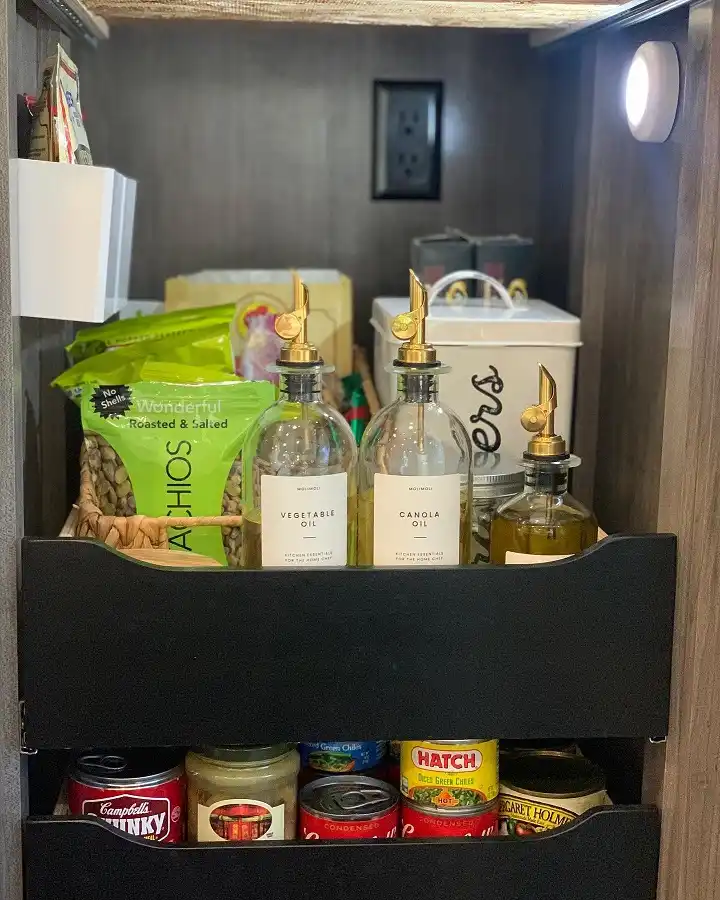
Store-bought oil bottles come in every shape and size, which is exactly why they clutter a small cabinet fast.
This shelf skips that problem entirely by decanting vegetable oil, canola oil, and what looks like infused oil into matching glass bottles with brass pour spouts, each one labeled by hand.
The result reads less like a pantry and more like a set of tools you would actually enjoy reaching for.
A battery puck light tucked in the top corner solves the other real problem with small enclosed cabinets, the dark back wall that swallows labels. No wiring needed, just stick and tap.
Below the oils, a slide-out black drawer keeps canned soups and green chiles from rolling behind the bottles, and a woven basket on the left corrals snack bags that would otherwise slump sideways.
7. Spring-Loaded Retention Bars Are the One Feature Snack Shelves Actually Need on the Road
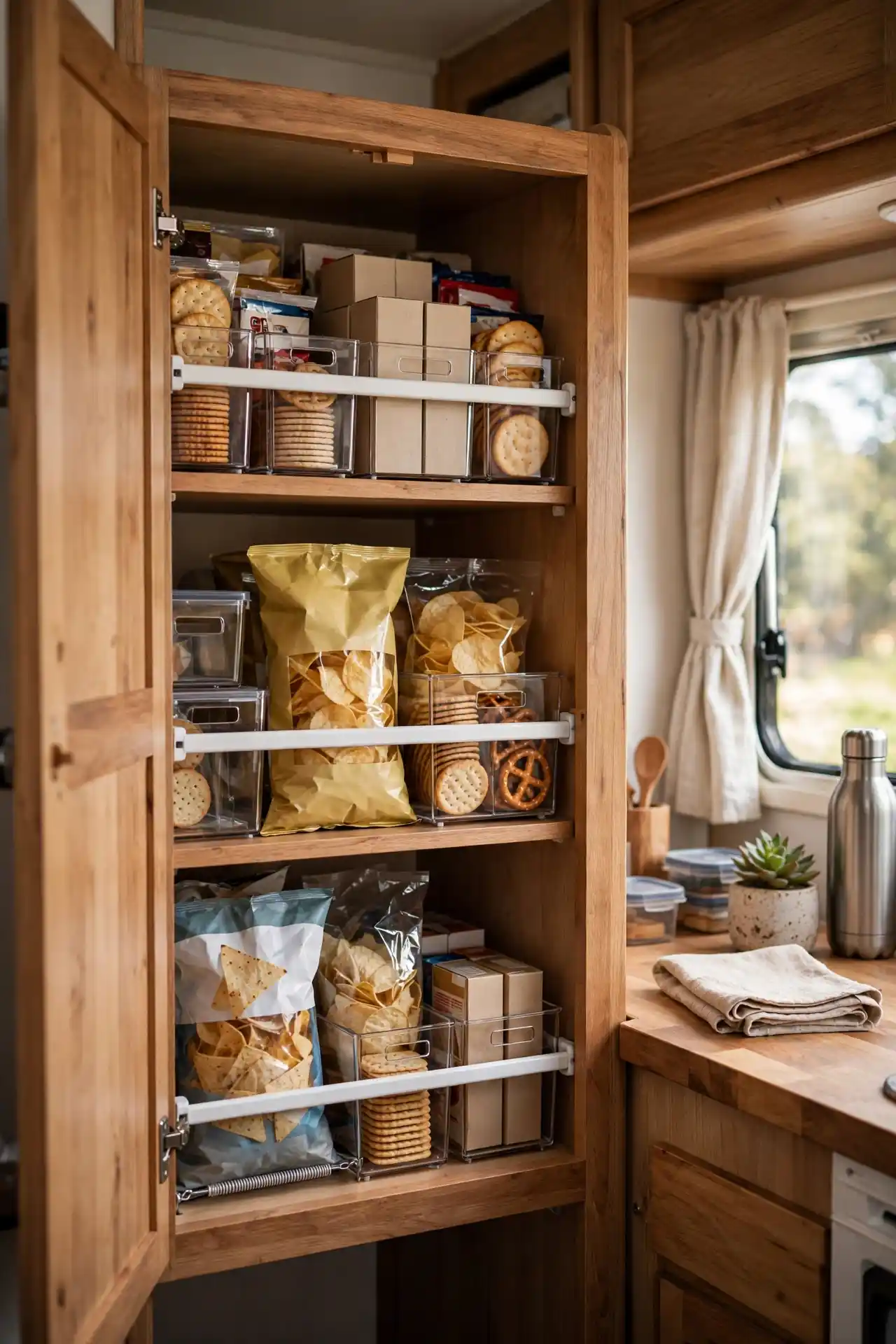
A pretty pantry that dumps chips onto the floor at the first sharp turn is not actually organized, it just looks that way parked in the driveway.
This cabinet gets the detail right that most home-style pantry photos skip: a white bar mounted across the front of every shelf, held in place with a spring clip you can see at the bottom door edge.
Clear bins still do the heavy lifting for sorting, crackers in one, chips in another, pretzels grouped with their neighbors, but the bar is what keeps a bag of chips from becoming a mid-drive projectile.
Each shelf gets its own bar rather than one long rail top to bottom, so a bin can still be pulled forward and lifted out from underneath once the vehicle is parked.
The wood tone matching the counter outside the cabinet is a nice touch, but it is not the point.
The point is that every one of these bins would survive a rough gravel road, which is the actual job of an RV pantry.
A retention bar across each shelf front is the difference between organized and organized-until-the-first-pothole.
8. Open Wire Baskets Let Fresh Produce Breathe Instead of Sweat in a Sealed Bin
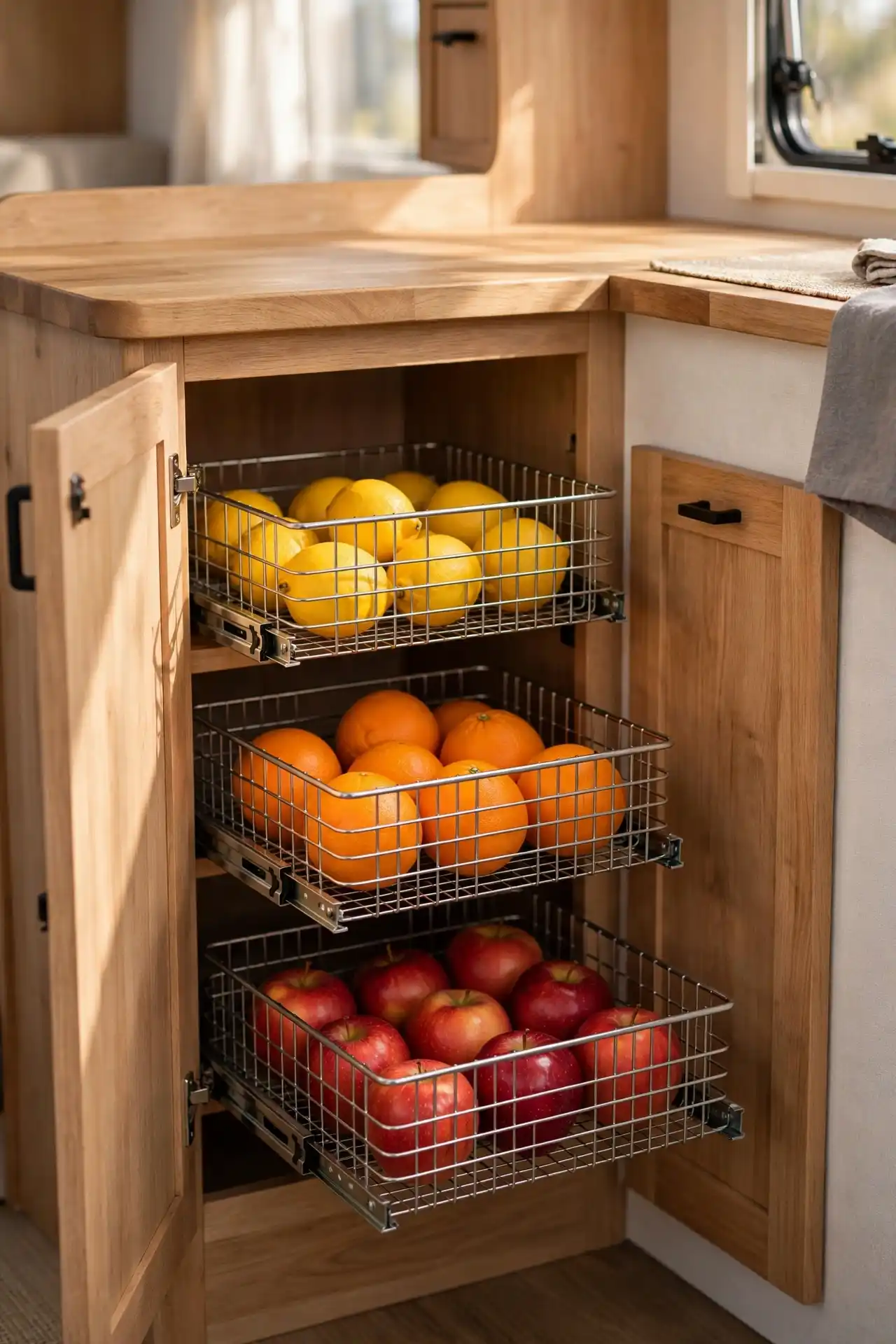
Fruit rots faster in an RV than at home, since cabin humidity swings more and airflow is harder to control.
This built-in cabinet answers that with three stacked wire baskets on slide rails, one fruit per basket, nothing sealed or bagged.
Air moves freely through every gap in the mesh, so lemons, oranges, and apples stay dry instead of sweating against plastic walls.
Sorting by fruit instead of mixing them matters here too. Citrus and apples give off different amounts of ethylene gas, and keeping them in separate baskets slows how fast any one batch turns soft.
The slide rails mean you never have to lift a heavy basket out to grab what’s on the bottom, you just pull the whole tray forward.
- One fruit type per basket, never mixed
- Wire mesh on all sides, not just the front, for real airflow
- Slide rails so the bottom of the basket is as reachable as the top
- No bags or liners inside the basket that would trap moisture
9. A Heavy-Duty Cabinet Latch Is the Upgrade That Makes Every Other Idea on This List Possible
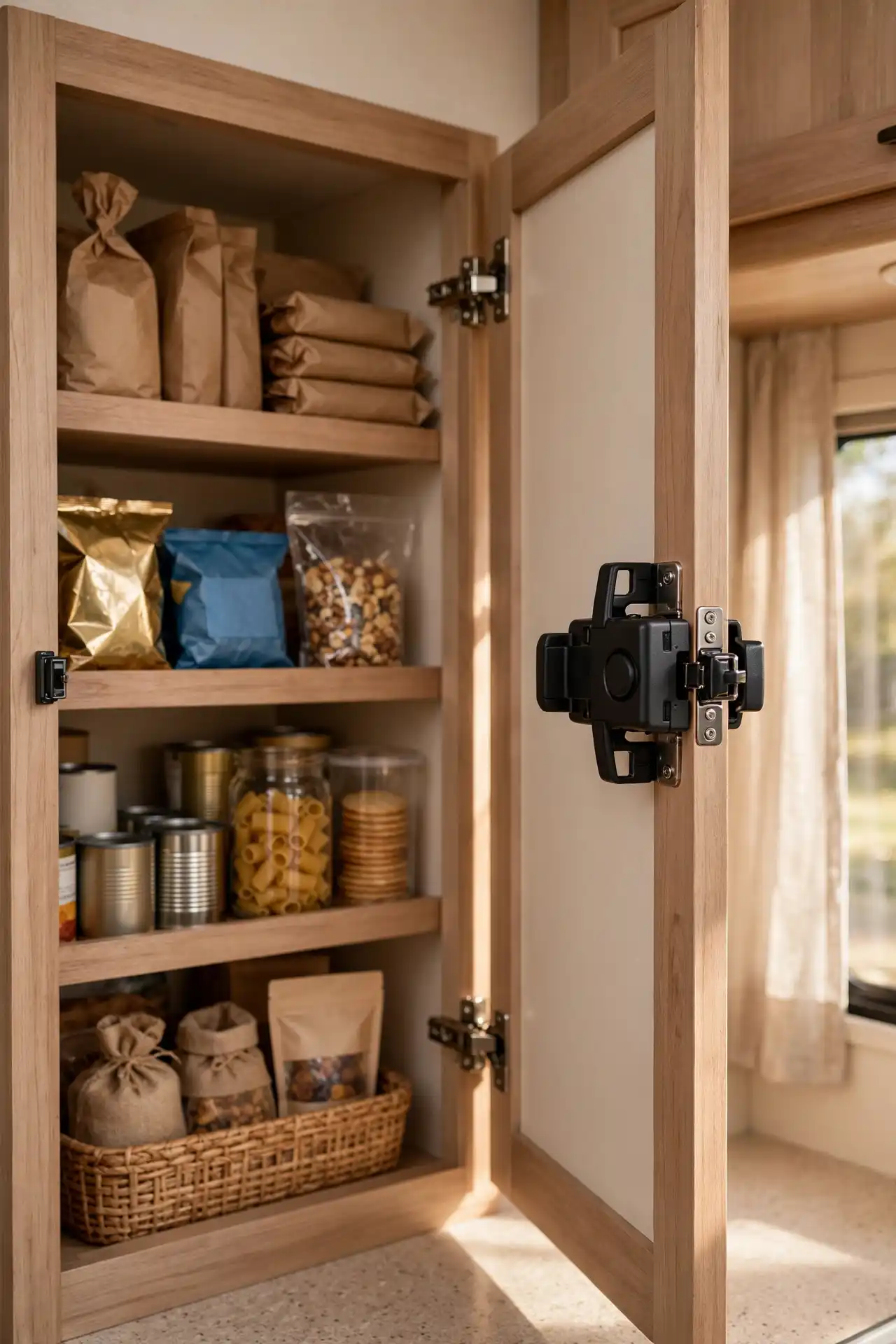
None of the open shelving, stacked jars, or unsecured baskets on the rest of this list work without one thing holding it all in during transit, and that’s the door itself.
This cabinet swaps a standard cabinet catch for a chunky, spring-loaded latch mounted flush on the door edge, the kind built to survive vibration rather than just look tidy in a photo.
Behind that latch, the shelving stays refreshingly simple. No bins, no dividers, just four open shelves holding kraft paper bags of grain, foil and paper snack pouches, jars of pasta and stacked crackers, and a woven basket corralling loose pouches on the bottom shelf.
It works because the latch is doing the job bins usually do elsewhere, keeping contents from sliding forward when the door swings.
- Check that your latch has a positive spring action, not just friction, so it resists popping open on rough roads
- Mount latches at both the top and bottom of tall doors, not just one point
- Pair a strong latch with simple open shelving if you’d rather skip bins and dividers
- Test the latch fully loaded, not empty, before you hit the road
10. Rubber-Lined Shelves Let Fresh Fruit Sit Loose Right Next to Portioned Snack Tubs
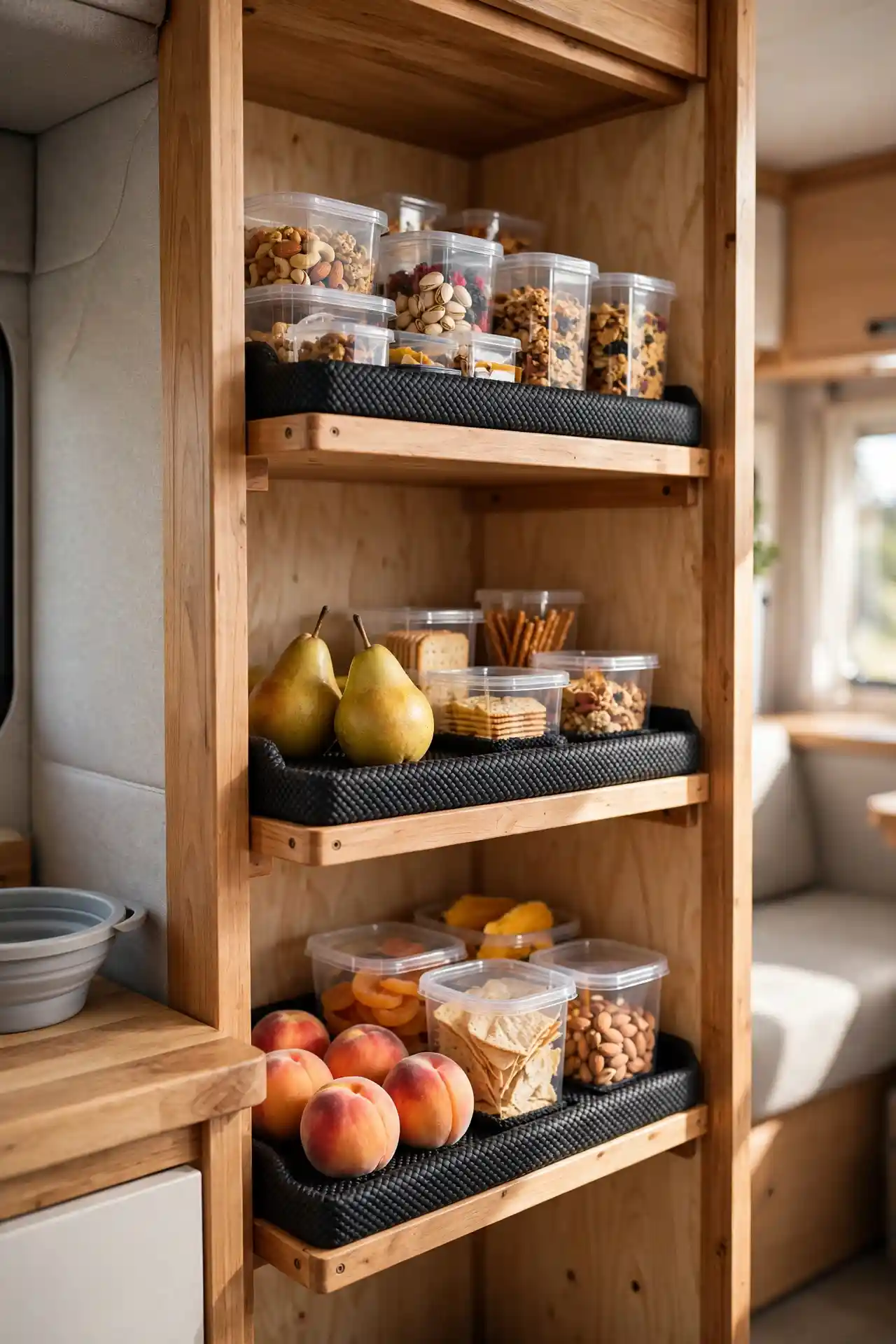
Nuts, dried fruit, and granola get their own individual clear tubs on this shelf, small enough that each one holds a single snack-sized portion instead of one giant bag everyone digs through.
Pears, peaches, and other fresh fruit sit unpackaged right alongside them, which only works because of what’s underneath both.
A textured rubber mat lines every shelf edge, and that’s the detail doing the real work.
Fresh fruit rolls the moment a rig takes a curve, and loose tubs slide the same way canned goods do. The grip mat holds both in place without needing lids, bins, or dividers to do it.
What works here:
- Portioning into small tubs turns one bulk bag into grab-and-go servings, cutting down on rummaging
- Fresh fruit stored unpackaged breathes better than fruit crammed into a sealed drawer
- A rubber shelf liner replaces the need for a raised lip or bin on every item
- Open shelves stay easier to wipe down than nested bins, which matters more with fresh produce around
Rubber shelf liner holds fruit and tubs in place without needing a lip or divider on every item.
Nuts and dried fruit split into snack-sized tubs so you’re not opening one giant bag every time.
Pears and peaches sit loose on the mat, since sealed containers trap moisture and speed up spoiling.
11. One Category Label Per Bin Turns Four Shelves Into a System Anyone in the Family Can Restock
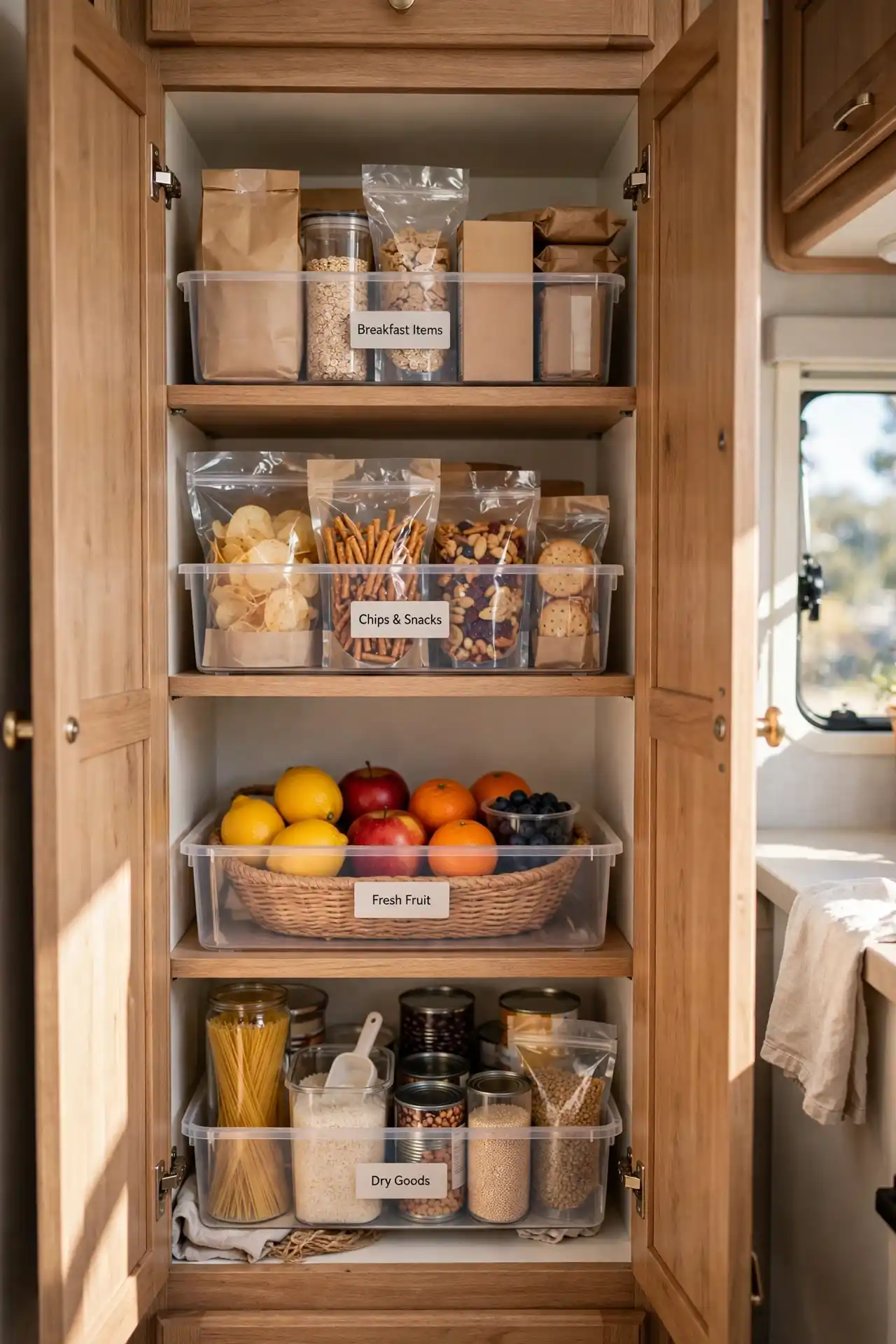
Every shelf in this cabinet gets the exact same treatment: one full-width clear bin, one printed label naming what belongs inside.
Breakfast Items, Chips and Snacks, Fresh Fruit, Dry Goods. That repetition is the whole point.
Once the system is this consistent, restocking after a grocery run stops being a guessing game, and anyone traveling with you can put something away correctly without asking where it goes.
The fresh fruit bin gets a smart exception to the bagged and boxed pattern everywhere else.
Lemons, apples, oranges, and blueberries sit in an open woven basket nested inside the clear bin, giving produce airflow while the outer bin still keeps it contained if the rig sways.
Notice the labels themselves stay printed and plain, no handwriting style, no color coding by category.
On a shelf already busy with different packaging colors and shapes, a quiet uniform label is what keeps the whole cabinet from feeling cluttered.
| Shelf | What’s labeled inside |
|---|---|
| Top | Breakfast Items |
| Second | Chips & Snacks |
| Third | Fresh Fruit |
| Bottom | Dry Goods |
12. A Bungee Cord Anchored to the Cabinet Wall Stops Open Shelving From Emptying Onto the Floor
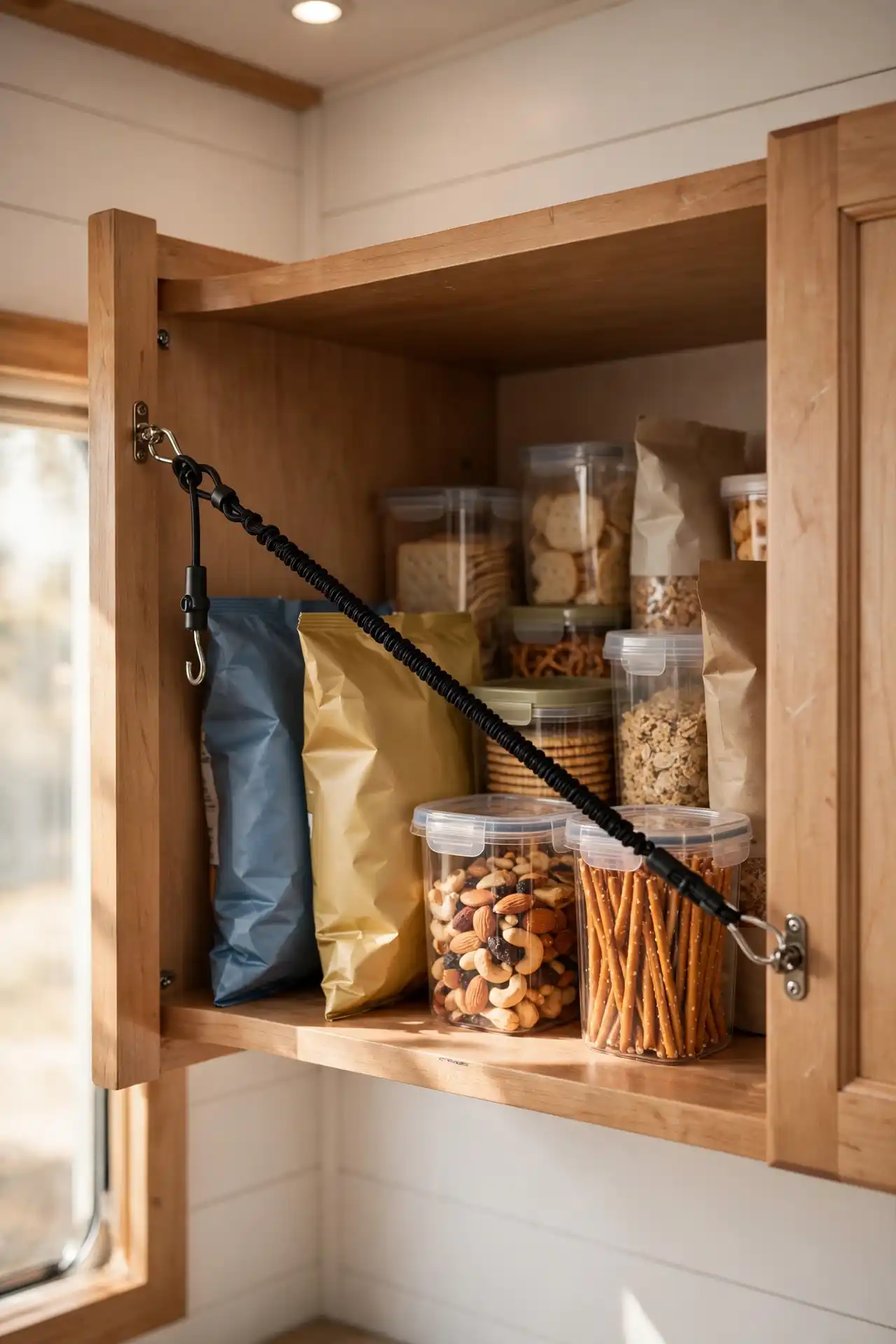
Open wood shelving looks great in every RV pantry photo, right up until the first hard brake sends everything sliding forward.
This cabinet keeps the airy, no-bin look but adds a stretch cord clipped between two eye hooks screwed into the side walls, running diagonally across the front of the shelf like a seatbelt for snack bags.
The hooks sit low enough to still let you reach past the cord for anything on the shelf without unclipping it first, and the stretch in the cord means it flexes with a shift in weight instead of snapping taut.
Bags of chips, pretzels, and trail mix stay upright behind it even though nothing here is boxed or bagged in a bin.
If you’d rather not drill extra hardware into cabinet walls, know what you’re trading away.
Open shelf, no anchor. Great to look at, first turn sends bags sliding off the edge.
Same open shelf, same bags, held in place by one stretch cord clipped between two hooks.
13. Slim Brass Rods Build Two Different Storage Zones Into One Cabinet Without a Single Bin
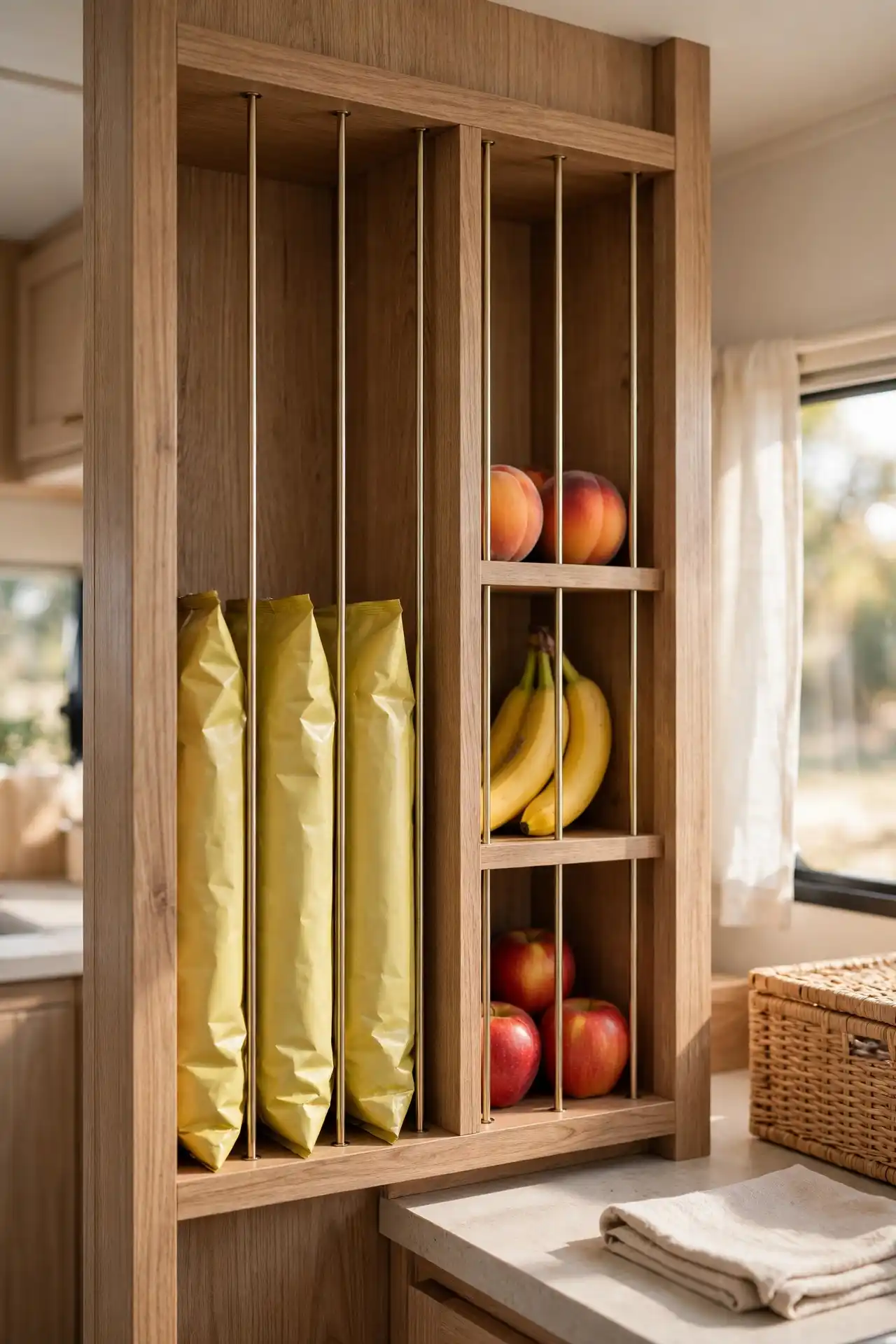
Tall snack bags need height and nothing else, while loose fruit needs small tiered compartments so nothing bruises under the next piece.
This cabinet splits its width to give each one exactly that, using nothing but vertical brass rods spaced like a wine rack instead of solid dividers or plastic tubs.
The left side runs full height with no shelf breaks at all, just rods spaced close enough to keep three tall coffee bags standing upright side by side.
The right side gets the opposite treatment: three shallow tiers, each just deep enough for one layer of fruit, so peaches on top never sit under the weight of apples below.
Rods on both sides let air move freely around everything stored, which matters more for the fruit side than the snack side.
- Full-height slot works for anything tall and rigid enough to stand on its own
- Shallow tiered slots work for fruit that bruises if stacked
- Rods, not solid walls, keep airflow moving on both sides
- No bin liners needed since nothing here can tip sideways
14. Fabric Drawstring Bags Replace Bins for the Snacks That Don’t Need to Be Seen
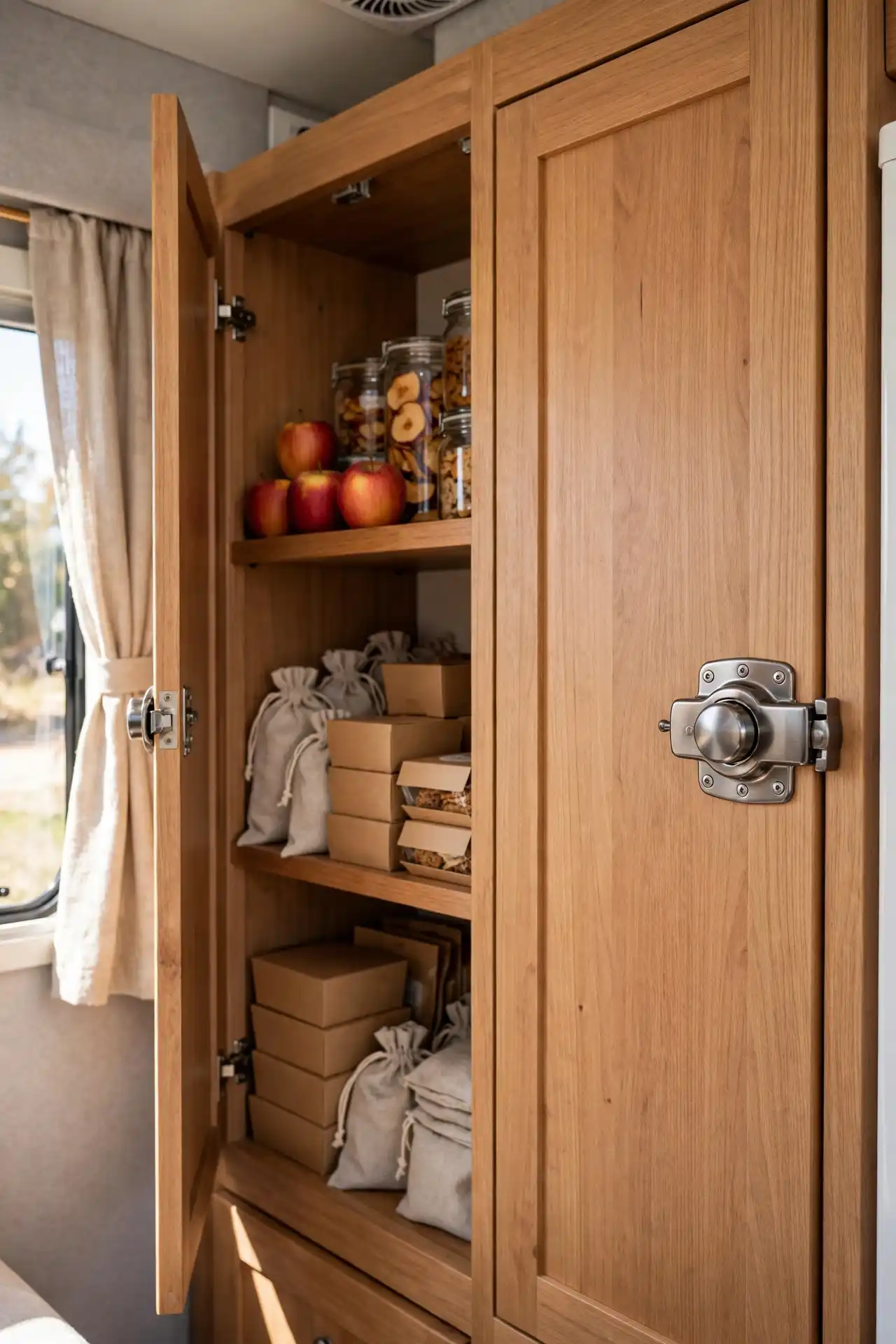
Not every pantry item benefits from a clear window. Dried fruit chips and trail mix already sit in labeled glass jars up top, but the lower two shelves switch strategy entirely, using soft cotton drawstring bags and stacked kraft boxes for items that store better in the dark, dry goods, baking mixes, anything sensitive to light.
The stacking matters as much as the bags themselves. Kraft boxes are uniform enough to stack four high without wobbling, and the drawstring bags tuck into the gaps between boxes instead of needing their own dedicated row.
Between the two, this cabinet fits noticeably more into two shallow shelves than a bin-and-lid system would allow in the same space.
On the door, a full deadbolt-style knob latch replaces the small metal catches typical of RV cabinetry, the kind homeowners install on cabin doors, not campers.
It’s a heavier fix than most rigs need, but it answers the same question as the latch in the earlier entry: standard hardware just doesn’t hold up to sustained road vibration the way people expect it to.
15. An Open Middle Shelf With Nothing but Loose Citrus Proves You Don’t Always Need a Container
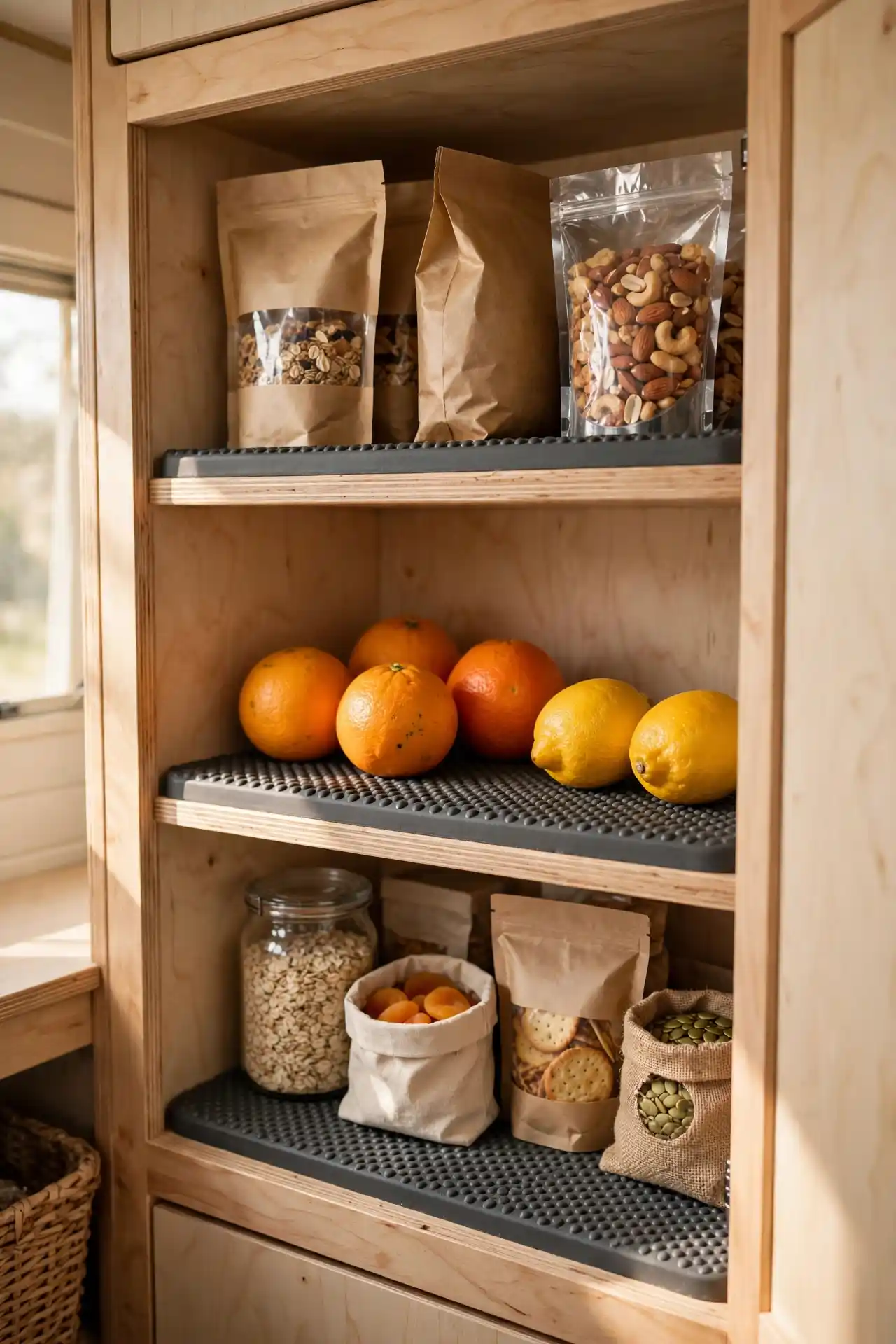
Every shelf in this cabinet uses the same textured rubber grip mat, but the middle one does something the others don’t: it holds nothing at all besides fruit sitting directly on the mat. No basket, no tub, no liner underneath the oranges and lemons.
That bare middle shelf is worth noticing because it shows the rubber mat alone is doing enough grip work that a container becomes optional, not required.
The shelves above and below make the opposite case. Dry snacks like granola and trail mix stay bagged in resealable pouches, and the bottom shelf mixes a glass jar of oats with soft canvas and burlap sacks holding dried apricots and pumpkin seeds, each material chosen for what it holds rather than one uniform system top to bottom.
- Loose fruit needs only a grip mat, not a bin, if the mat has enough texture
- Resealable pouches work fine stacked directly on a mat shelf without extra bins
- Match container material to contents: canvas for soft dried fruit, burlap for seeds, glass for oats
- A shelf with nothing on it but a mat is not an unfinished shelf, it is doing its job
16. A Stepped Acrylic Riser Turns One Flat Shelf Into a Front-Facing Display You Can Read at a Glance
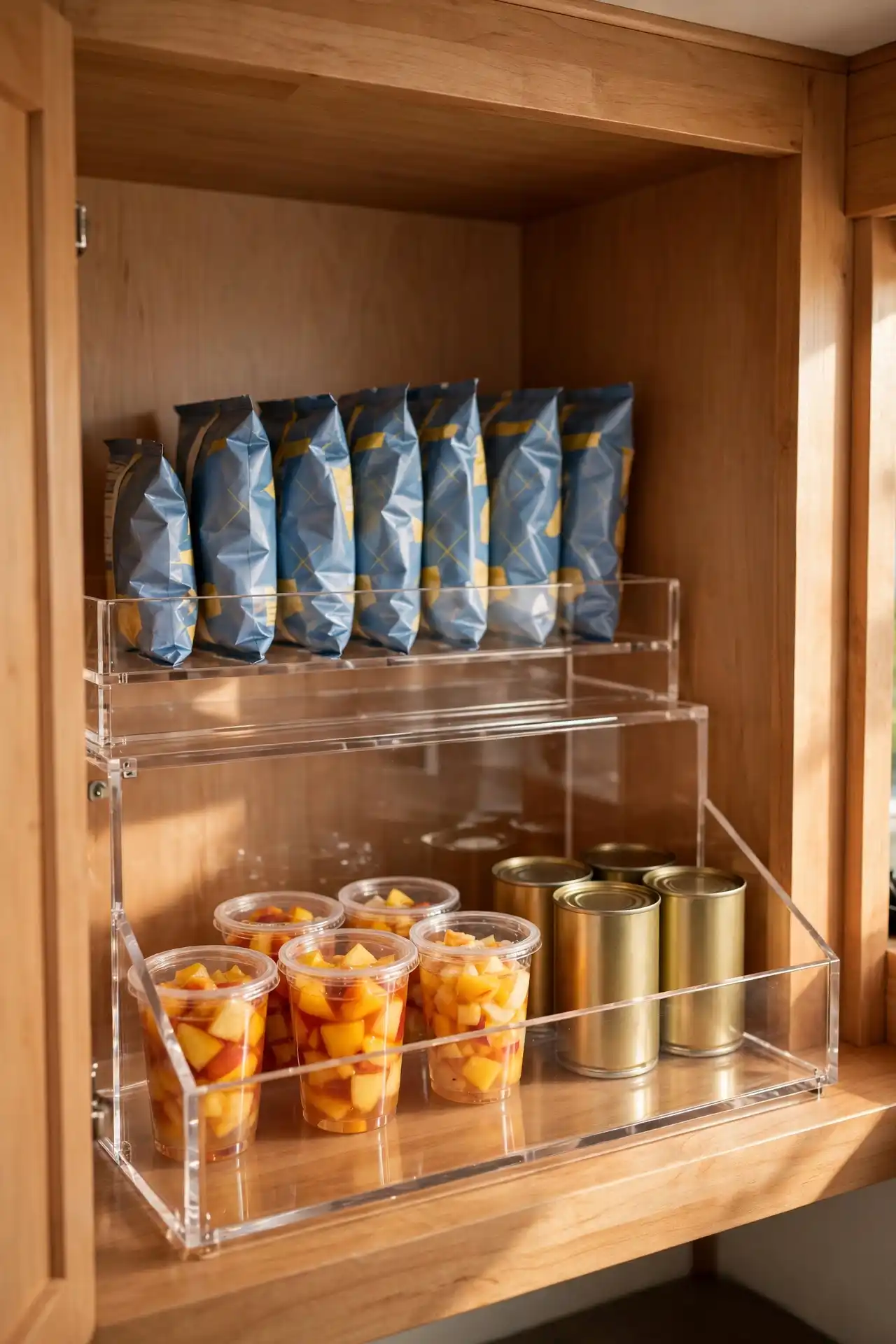
The last idea on this list solves a problem specific to deep cabinets: whatever sits at the back of a flat shelf disappears from view the moment the front row fills up.
This clear acrylic riser fixes that with two tiers, a raised back level for snack bags and a front tray at cabinet-floor height, so nothing in the back row is ever hidden behind something in front.
The bottom tray earns its keep by mixing categories that would normally get separate bins.
Pre-portioned fruit cups sit right next to canned goods, since both are grab items you want visible and reachable without digging.
That front tray also has a raised lip, so the whole thing can be slid forward like a drawer without spilling its contents onto the shelf below.
Being clear from every side means the riser adds structure without adding visual clutter, which matters in a cabinet already busy with mixed packaging.